
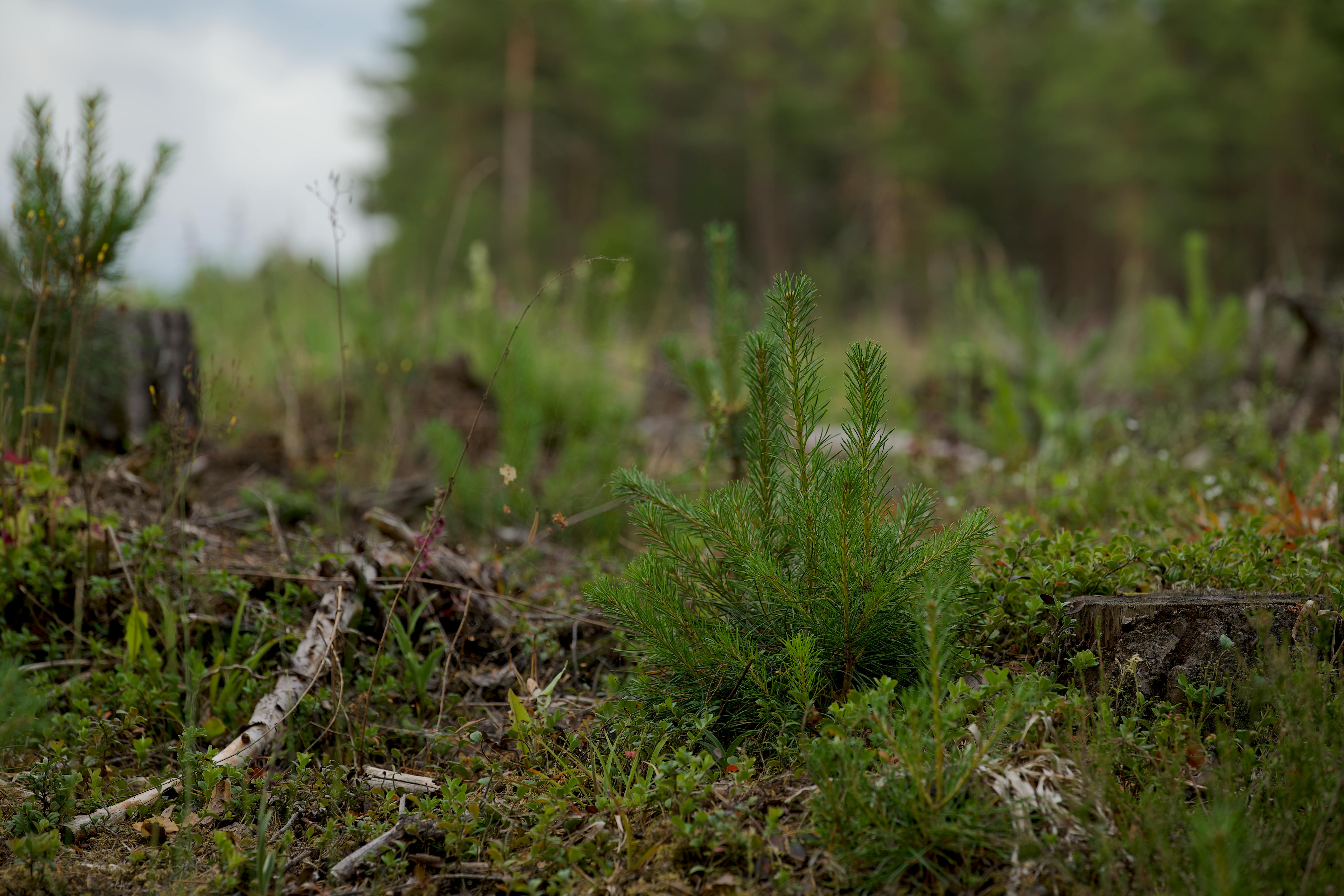
Timberland is often presented as an inflation hedge, a source of stable returns and a diversifier against public markets. These characteristics can be relevant, but none of them is automatic.
A forest portfolio is exposed to timber prices, interest rates, operating costs, local processing capacity and physical risks. At the same time, it has two characteristics that distinguish it from most traditional assets: the underlying inventory can continue to grow biologically, and the manager may have some discretion over when that inventory is harvested.
The resulting risk-return profile is therefore shaped by more than changes in timber prices. It reflects the interaction between biological growth, product-class development, harvest timing, land value, potential carbon income and active asset management.
Return potential begins with net biological growth
The physical inventory of a forest changes over time. Trees add volume and, depending on their species, age, site conditions and management, may move into higher-value product categories.
This biological growth is not cash income. It represents an increase in the quantity and potentially the quality of standing timber. The economic benefit is realised only when timber is harvested, the property is sold or the additional inventory is reflected in an updated asset valuation.
A peer-reviewed study comparing timber investment models across the United States, Brazil, Chile and Poland found that, excluding land price, biological growth and timber prices were the most influential variables affecting projected internal rates of return. Their relative importance, however, varied materially by geography, species and management regime. US Forest Service: Profitability and risk sources in global timberland investments.
Biological growth should therefore be underwritten as net increment rather than treated as a fixed or guaranteed annual return. Gross timber growth must be considered alongside mortality, harvesting and potential losses from natural disturbance.
Wildfire, storms, drought, pests and disease can affect recoverable timber volume and product quality, but their relative importance differs substantially between forestry markets. Wildfire may be a principal risk in some fire-exposed regions, while Baltic portfolios have a different risk profile in which wind damage, localised pest outbreaks, drought and the manager's operational response may be more relevant.
Latvia maintains public monitoring and forest-management guidance for risks such as the European spruce bark beetle. Current monitoring indicates that its population has declined following the earlier outbreak period. Latvian State Forest Service: European spruce bark beetle.
The investment implication is not that biological growth is unreliable. It is that growth assumptions must reflect local conditions and the manager's ability to monitor and respond to biological and operational changes.
Property-level growth-and-yield models should therefore reflect:
- species and age distribution;
- soil productivity and site conditions;
- stand density and resilience;
- planned thinning and regeneration;
- historical mortality and natural disturbance;
- exposure to pests, disease, drought and wind damage;
- monitoring frequency and early-detection capability;
- the manager's ability to undertake timely preventive or sanitary measures;
- the intended timber product mix.
For institutional underwriting, the relevant question is not simply how quickly a forest can grow. It is how much commercially recoverable volume is expected to remain after biological and operational losses — and whether that net growth adequately compensates investors for management costs, inflation, the required return on capital and the risks associated with holding the asset.
Harvest optionality: valuable, but not costless
Unlike many commodity producers, a forest owner may be able to defer a final harvest when timber prices are weak. If the stand remains biologically productive, the trees may continue adding volume while the manager waits for more favourable market conditions.
This creates a form of real optionality: the asset can sometimes be held rather than sold into a depressed market.
Research on forest investment decisions confirms that timber-volume uncertainty and changing timber prices affect the optimal timing of inventory work and harvesting. Better inventory information can reduce uncertainty and improve the predictability of expected returns. US Forest Service: Measure twice, cut once.
However, harvest optionality is neither unlimited nor free. Deferral may become unattractive where:
- biological growth has slowed;
- mature trees face increasing mortality or storm risk;
- holding and management costs continue to accumulate;
- the portfolio requires operating cash flow;
- debt covenants or repayment schedules restrict flexibility;
- market access or harvesting permits impose timing constraints;
- the expected price improvement does not compensate for the cost of capital.
A forest can continue growing while its discounted economic value declines. The manager must therefore compare the expected value of waiting with the return that could be earned by harvesting and redeploying the capital.
Financing structure determines how much of this flexibility the manager retains. Because forestry cash flows are long-dated, higher required returns can reduce the present value of future harvests, while excessive leverage may force timber sales to meet interest or principal payments. Harvest optionality is therefore most valuable when the portfolio combines sufficient liquidity with conservative financing and is not required to sell timber during temporarily weak markets.
Timber does not have a single market cycle
A forest portfolio does not produce one uniform commodity. Sawlogs, pulpwood, energy wood and specialised products respond to different end markets.
Construction affects demand for sawnwood, structural panels and engineered wood. Manufacturing influences packaging, furniture and other processed products. Pulp and paper demand follows a different cycle, while energy policy affects the market for pellets and other forms of wood fuel.
The differences between these markets were visible in the latest consolidated global data. According to the FAO, global production of industrial roundwood increased by 2% in 2024, while wood-based panel production increased by 5% and wood-pellet production by 2%. Sawnwood production was broadly unchanged. FAO: Global production and trade in forest products in 2024.
These are global figures and should not be used as a proxy for Baltic timber prices. They illustrate a more fundamental point: demand can move differently across product categories, even within the same economic period.
Portfolio performance is therefore influenced by:
- the species and quality of standing timber;
- the proportion suitable for sawlogs, pulpwood or energy use;
- proximity to mills and export infrastructure;
- regional processing capacity;
- harvesting and transportation costs;
- the financial position of local timber buyers.
Two forests with similar standing volume can have materially different economic values if their product mix, accessibility or distance to processing facilities differs.
A diversified timber profile and access to several processing channels may therefore be as important as total standing volume.
Land value is a separate return component
Timberland value includes both the standing timber and the land supporting future rotations. Land may also have value associated with location, agricultural use, infrastructure access, recreation or other legally permitted uses.
This means that total return may include land appreciation in addition to timber-related income and biological growth. However, land appreciation should not be assumed.
It depends on local transactions, title quality, zoning, access, market liquidity and the availability of alternative uses. A higher-and-better-use opportunity can create value in one property while being irrelevant to another.
Institutional analysis should therefore separate:
- operating cash flow from timber and leases;
- changes in standing timber inventory;
- changes in timber prices;
- changes in the underlying value of land;
- value created through active management or selective disposals.
Without this decomposition, appreciation caused by changing valuation assumptions can be mistaken for operating performance.
Carbon value: potential upside, not base-case return
Forests store carbon as part of their biological growth, but carbon sequestration does not automatically create a carbon credit or an additional revenue stream.
To generate marketable carbon units, a project must demonstrate that the claimed climate benefit is measurable and additional to an appropriate baseline. It must also address monitoring, independent verification, permanence, potential reversal and the risk of double counting.
The EU Carbon Removals and Carbon Farming Certification Framework establishes a voluntary certification framework based on quantification, additionality, long-term storage and sustainability. Certified units may be issued only following independent verification under an applicable certification methodology. Regulation (EU) 2024/3012.
For institutional underwriting, it is important to distinguish between:
- carbon physically stored in the forest;
- an activity that may qualify under a carbon methodology;
- independently verified and issued carbon units;
- contracted revenue from the sale of those units.
Only the final category represents a clearly identifiable cash flow. Potential future carbon credits should therefore be treated as optional upside unless eligibility, ownership, verification costs, issuance timing and access to buyers have been established.
Carbon management may also interact with the timber strategy. Extending rotations or changing forest-management practices may increase carbon storage, but it can defer timber revenue, alter the harvesting schedule and create longer-term permanence obligations.
The same biological growth should not be counted simultaneously as unrestricted timber value and fully monetisable carbon value without reflecting these constraints.
A disciplined valuation should therefore separate core forestry returns from potential carbon-related income and model the latter through base, downside and upside scenarios.
Inflation and diversification: relevant, but horizon-dependent
Timberland may provide some protection against inflation because timber prices and land values are connected to the real economy, while biological growth continues in physical rather than nominal terms.
The empirical evidence is nevertheless more nuanced than the general "inflation hedge" label suggests.
A study of United States timberland returns between 1987 and 2009 found that US private-equity timberland provided protection against actual, expected and unexpected inflation. However, the effect was weaker during recessions and became more consistent over longer investment horizons. Publicly traded timberland did not provide the same consistent characteristics. Forest Science: Assessing the Inflation Hedging Ability of Timberland Assets.
The evidence relates to the United States and should not be treated as a forecast for European forestry. It does, however, demonstrate that inflation protection is better understood as a potential long-term portfolio characteristic than as a contractual hedge.
Timberland may also provide diversification because its return drivers are not identical to those of listed equities or conventional fixed income. Biological growth, local timber markets, land values and harvest timing introduce sources of return that are partly independent of daily public-market movements.
A peer-reviewed United States study found that private-equity timberland retained a diversification role across different investment horizons. It also concluded that serial correlation and the length of the holding period materially affected measured volatility and portfolio outcomes. Forest Science: Volatility Decay and Diversification Role of Timberland.
Timberland should therefore be viewed as a potential long-term diversifier, not an asset whose inflation protection or portfolio benefit can be assumed before underwriting.
Physical and operational risks can be actively managed
The biological nature of forestry creates physical and operational risks, but it also allows many of those risks to be identified, monitored and managed at property level.
Relevant exposures include fire, windthrow, drought, pests, disease, regeneration failure, illegal harvesting, environmental restrictions and contractor risk. Their probability and financial impact vary substantially by geography, species, age distribution and management quality.
Research by the European Commission's Joint Research Centre identifies fire, windthrow and insect outbreaks as important sources of disturbance in European forests and emphasises the role of forest structure and local conditions in determining vulnerability. European Commission Joint Research Centre: Vulnerability of European forests.
These risks cannot be removed completely, but exposure can be reduced through:
- geographic, species and age-class diversification;
- active forest-health monitoring;
- preventive silviculture;
- appropriate access and fire-management planning;
- timely sanitary measures;
- insurance where economically available;
- conservative leverage;
- contingency reserves;
- documented contractor and supply-chain controls.
Technology can strengthen these controls. Satellite monitoring, LiDAR, forest inventories and geospatial analysis can help managers identify changes earlier, prioritise field inspections and maintain more consistent portfolio records.
For institutional investors, the relevant question is therefore not whether physical risk exists. It is whether the portfolio identifies material exposures early and has the operational capability, financial flexibility and documented procedures to respond effectively.
The institutional conclusion
The distinctive feature of timberland is not that it avoids economic cycles. It is that several return drivers operate on different timelines.
Biological growth can increase physical inventory. Harvest flexibility may allow a manager to defer some revenue. Timber prices connect the portfolio to construction, manufacturing, paper and energy markets. Land value introduces an additional real-estate component. Verified carbon projects may provide supplementary income where eligibility and monetisation have been established.
Active management determines how these elements are converted into cash flow and long-term value.
These characteristics can support an attractive role in a diversified real-asset portfolio. Their contribution will depend on acquisition price, portfolio composition, market access, financing structure, management quality and the investor's holding period.
For an investment committee, the central question is therefore not whether timberland is inherently defensive. It is whether a specific portfolio has been acquired at an appropriate price, financed conservatively, measured consistently and managed with sufficient flexibility to allow its biological and operational advantages to work through the cycle.
Explore tFOREST — 3Pine's approach to forest-backed digital securities.
This article is provided for informational purposes only and does not constitute investment advice, an offer or a solicitation to invest. Financial instruments may be available only to eligible professional or qualified investors and remain subject to their applicable offering documentation. Investments involve risk, including the possible loss of capital.